Pain, Recovery, and Predictive Processing: That Time I Almost Missed Out on Delicious Papaya
In 2024, my husband and I relocated from Mexico City to London. And I can’t tell you how much I started missing the tropical fruit I always had for breakfast in Mexico. After much searching, we found a local grocer who had papayas from Brazil.
A couple of months ago my husband went to buy papaya. He called to say they didn’t have any from Brazil this time, only a couple from Colombia, and they didn’t look that great, but did I want him to buy them anyway? After some hesitation, I said yes, get two.
He brought them home, and they were fine, just not very pretty, and they were not yet ripe. We left them to ripen on the counter, wrapped in newspaper for a few days, and one morning as I got ready to slice one, I noticed the label. It said “Colomba,” not “Colombia,” and it had a tiny Brazilian flag.
I called my husband, who was travelling, to tell him. He immediately said, “No, no, the label has the colours of Colombia: yellow, blue, and red, and it says Colombia.” I sent him a picture. (See below!) The label was indeed blue and yellow, and since it had a picture of a papaya on it, there was also some red. His brain had filled in the missing “i” to make the word “Colombia,” and it completely missed the little Brazilian flag.
By the way, the papaya was absolutely perfect: juicy, fresh, sweet, delicious. (Again, see below!)
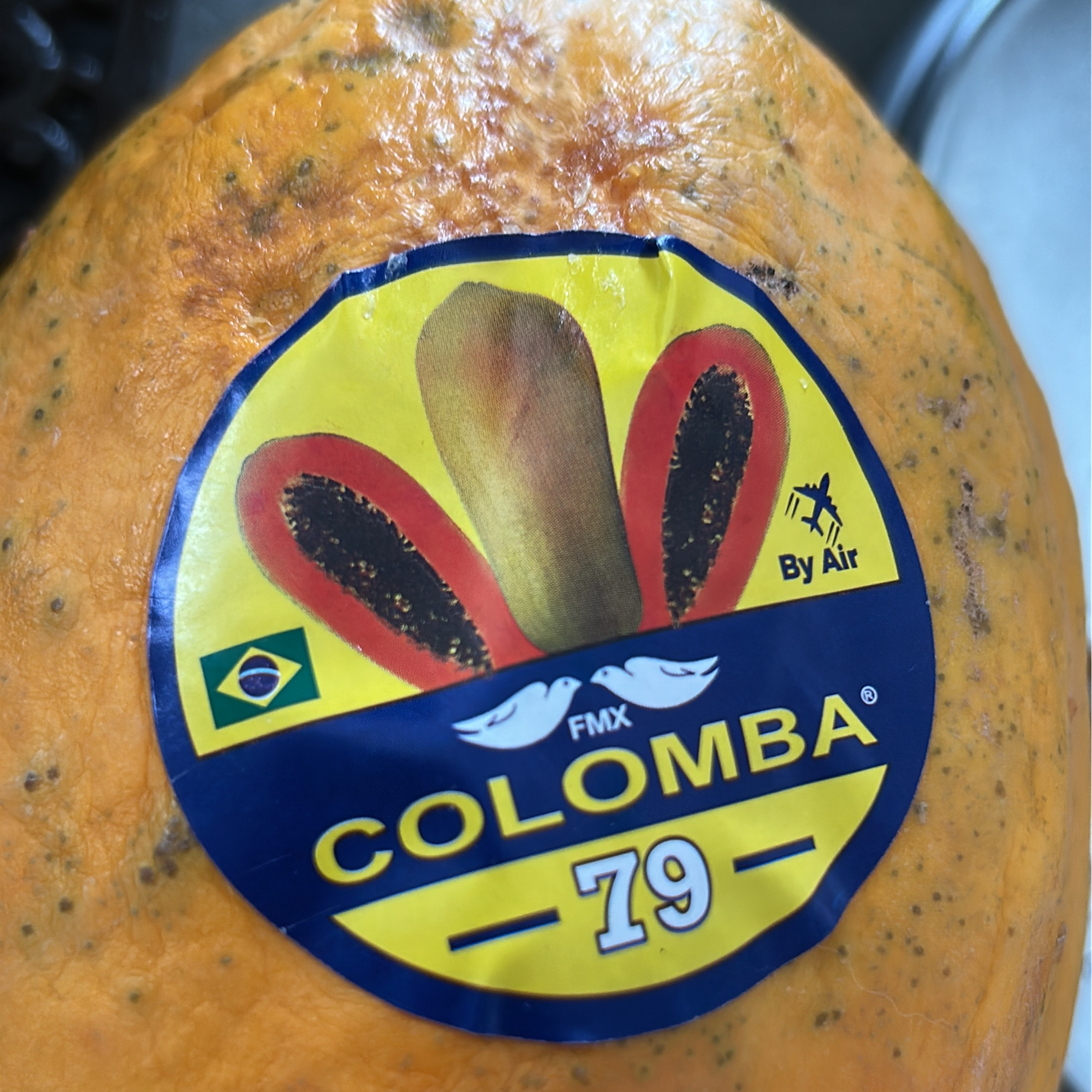

This experience is also a perfect example of predictive processing at work. Our brains are constantly making rapid predictions about what we expect to see, hear, or feel, based on our prior experiences. When the information coming in is incomplete or a bit ambiguous, the brain fills in the gaps with what it thinks is most likely. That’s usually very efficient; it lets us move through the world without stopping to re-evaluate every detail. But sometimes, as in this case, those predictions override the actual evidence in front of us.
Predictive processing isn’t limited to what we see; it also applies to what we feel in our bodies, including pain. Over time, through repeated experiences, our brains learn to predict what certain signals mean. If we have lived with pain for a while, our brain may start to expect pain in certain contexts, even when our body is healing or an injury has resolved. The nervous system learns that certain cues—like a movement, a posture, or even a situation—mean danger, and it generates a pain response in anticipation.
This is what’s often described as a conditioned response. The brain links certain experiences with pain or threat, and then reproduces that response automatically. It’s not that the pain isn’t real; it’s that the brain’s prediction of pain has become stronger than the sensory evidence that you are actually safe.
In predictive coding terms, pain can be understood as the brain’s best guess about the body’s state in that moment. When the brain’s predictions are overly weighted toward protection, pain can persist even without ongoing tissue damage. The good news is that because our brains are plastic and adaptable, these predictions can change. Through new experiences of safety, movement, and self-regulation, the nervous system can learn that not every sensation signals danger.
Just like my husband’s brain confidently saw “Colombia” and missed the Brazilian flag, our brains can confidently predict pain even when it’s no longer needed. But with awareness and curiosity, we can start to help the brain update its model of what is actually happening now, not what it expects from the past.
When we start to understand how predictions happen, we can hold more compassion for our experience while also bringing greater intention to our choices. When we make decisions based on predictions of threat or disappointment, we often limit what we can notice or try. We narrow our focus to avoid those outcomes, and in doing so, miss possibilities for comfort, connection, or pleasure. We miss small moments of delight, like the sweetness of a delicious papaya, the satisfaction of moving our bodies, or the comfort of genuine connection.
Recognizing this pattern isn’t about judging ourselves; it’s about learning to notice when our predictions are overly cautious and creating room for new experiences that gently challenge those predictions and remind our nervous system that safety and delight are possible, even if pain is present for now.
And when we offer our nervous system examples to recalibrate and start making predictions of vitality, curiosity, and connection, new patterns can emerge, and life can feel more open, vibrant, and full.
The Takeaway:
Buy the papaya (or tropical fruit of your choice) and allow it to ripen.
Our brains are always predicting, and sometimes they get it wrong. Pain can be one of those predictions, shaped by past experience – but ready to be updated.
Can you think of a time your brain confidently “filled in the gaps”, only to realize later that it got the story slightly wrong? What might that tell you about how your own predictions play out in your body?
This entry has been edited by my dear friend and colleague Melissa Tiessen, as part of her From Pain to Possibility series. You can sign up to her newsletter here and receive a supportive free resource here.
The ideas expressed here reflect my thinking at the time of writing. As my understanding evolves, some of what I've shared may no longer feel current or fully aligned with where I am by the time you read this. Take what resonates, and leave what doesn't. I hope something here supports you in finding greater ease and freedom.
About the author:

Dr. Lilia Graue is a physician, psychotherapist, and mindbody healing mentor.
After living with chronic pain for more than a decade, she found freedom through an integrative mindbody approach grounded in neuroscience, mindfulness, and compassion.
She is passionate about helping people who are living with chronic pain, fatigue, long COVID, and other persistent symptoms to find freedom and reconnect with joy, vitality, purpose, and agency. She also loves mentoring fellow practitioners—therapists, coaches, and clinicians— to support them in creating trauma-integrative, relational, and sustainable healing spaces, while keeping their sanity and their passion and thriving personally.
With over 25 years of experience in medicine and psychotherapy, Lilia’s work prioritizes consent, curiosity, and co-creation, honoring individual context, systemic influences, and the power of genuine relationship in supporting long-term change and healing. She works with people globally in both English and Spanish.
Originally from Mexico City, she currently lives in London with her husband and the two rescue cats who own them, Ziggy and Lupito. In addition to her work, she loves spending time in nature, baking, reading, traveling, and enjoying live music.
Get more insights in your inbox through The Enchanted Loom*.
The Enchanted Loom is a metaphor for the awakening brain by pioneering neuroscientist Charles Sherrington.